Let’s cut to the chase: if you run a trampoline park, own a backyard play space, or work in rec facilities, you probably take the safety net around trampolines for granted. Until—well—you don’t. I’ve been in the trampoline game for over a decade, running a supply for trampolines with safety nets, and I’ve seen firsthand how a “fine” net one week can turn into a near-disaster the next. The signs of a worn-out safety net aren’t always obvious at first—they creep up on you, like a loose screw or a broken spring you almost missed. Today, I’m breaking down the quiet, easy-to-miss red flags that your safety net’s toast, no fancy jargon needed. Trampolines with Safety Nets
First, let’s talk about the stretch. Not the “this net fits a little loose after 6 months” stretch—we’re talking about the kind where you can stretch a section 2x its normal size with just one hand. I saw this at a small indoor park last spring; the owner swore his net was “still in good shape” because it didn’t have holes. But when we checked, the mesh had stretched so much that the gap between the top of the trampoline mat and the net’s inner wall was almost 18 inches. That’s enough for a kid to slip through mid-bounce, right before they hit the edge of the frame. Here’s the science bit: trampoline nets are made from high-density polyethylene (HDPE) or polyester mesh for a reason—they’re engineered to have a specific tensile strength to stretch just enough on impact, but not permanently. Over time, UV rays from the sun (or even indoor UV lighting) break down the polymer chains, making the mesh lose its memory. It doesn’t snap back like it’s supposed to. If you test a small, unnoticeable section—like the corner no one ever jumps near—and it stretches way more than the rest, that’s a big red flag. I always tell clients to do this monthly: grab a 2-foot section of net, pull gently. If it stretches past 3 feet easily? Ditch it.
Next up: fraying that’s not just “cosmetic.” I’m not talking about a few loose threads at the top edge (those happen from kids grabbing the net when they climb on or off). I’m talking about frayed strands inside the mesh. If you run your fingers along the net and feel rough, fuzzy patches—like old carpet, not smooth mesh—or see tiny, broken fibers sticking out in clumps, that’s a sign the net’s core is failing. A lot of people brush this off as wear and tear, but HDPE and polyester mesh don’t fray like cotton. Fraying in the mesh means the individual strands that make up the net’s structure are breaking. I had a client a couple years back who thought his net was fine because the only fraying was along the bottom, where it meets the trampoline frame. We pointed out the frayed strands inside the middle section, and he laughed it off—until a 7-year-old bounced into the net, the strand gave way, and they fell 3 feet onto the concrete floor below. He replaced that net within a week, and now he texts me every month to remind his staff to check the “invisible fraying” spots. Pro tip: shine a flashlight through the net at night, when it’s dark outside. You’ll see tiny gaps where strands are broken, or fuzzy lines you can’t see during the day. That’s not just old—it’s dangerous.
Then there’s the gaping holes. Wait, I know what you’re thinking—“Holes are obvious, duh.” But hear me out: not all holes are big ones. A lot of time, small, pinprick holes start popping up in high-traffic areas: right by the ladder, near the spot where kids land after a big flip, or along the seams that hold the net panels together. Those tiny holes might not let a kid through right away, but they’re the start of a tear. I’ve seen a net with 20 tiny pinprick holes turn into a 2-foot tear in 2 weeks because each hole is a weak point that gets pulled wider every time someone bounces into it. Also, check the seams—where two net panels are stitched together, or where the net connects to the top bar of the trampoline frame. If the stitching is coming loose, or if the seam is stretched so far it’s separating, that’s a massive issue. Seams are the net’s strongest part when they’re intact; once they fail, the whole net can come apart in a split second. Last year, a backyard customer sent me a video of her kid bouncing and the net’s seam at the top giving way—she said she’d noticed a tiny thread loose a month prior, but thought it was “no big deal.” It was, and we fixed her up with a heavy-duty commercial net that has double-stitched seams.
Oh, and let’s not forget the hardware that holds the net in place. A lot of people focus only on the mesh, but the poles, clips, and anchors are part of the safety net system too. If the poles that hold the net upright are bent (even slightly, not the obvious “crushed” bend), that means they can’t support the mesh’s weight during impact. I’ve found bent poles in both backyard and commercial setups—usually from someone setting up the net wrong, or from a kid leaning too hard on the poles. If the clips that connect the net to the top frame are cracked, or if the plastic anchors that hold the net’s bottom to the ground are loose, that’s another sign of a worn-out system. One park I work with had their net’s plastic anchors break during a rainy weekend; when we came to replace the net, we noticed the poles had hairline cracks that were only visible when we wiped off the dirt. They would’ve collapsed if someone had done a double backflip. Hardware doesn’t last forever either—plastic degrades in sunlight, metal can rust even if it’s coated, and clips wear out from being snapped and un-snapped thousands of times. If you see any of that hardware looking less than perfect, don’t just replace the part—replace the whole system if it’s old, because matching new hardware to old, worn poles or mesh is a waste of time and money.
Wait, here’s a less talked-about sign: the net is discolored, and not the “vintage” kind. A net that’s faded to a dull gray instead of its original bright color—whether that’s blue, green, or black—has been exposed to too much sun or chemicals, and its tensile strength is dropping. Bright, vivid colors in trampoline nets come from UV-stabilized dyes. Once that dye fades, the UV stabilizer is gone too, so the mesh is breaking down from sunlight even faster. I see this all the time in backyard trampolines that sit on patios all year, no cover. The net fades to a pale, washed-out color within 1-2 years, and by year 3, it’s barely holding up. Commercial parks that have indoor nets might not get sun, but they get cleaning chemicals (used to sanitize after kids) that eat away at the mesh too. A net that’s looking dull or stained with weird, permanent marks—marks you can’t wipe off with a mild cleaner—is a net that’s already lost some of its strength. Don’t wait for it to fail to replace it.
Let’s be real: a lot of people ignore these signs because replacing a trampoline net (or the whole system) costs money. But here’s the thing— a worn-out safety net isn’t just an inconvenience. It’s a liability. I’ve seen first-hand how a kid falling off a trampoline because of a bad net leads to ER visits, lawsuits, and lost business. And the worst part? Most of these issues are totally preventable, if you just know what to look for.
Now, I’ve spent 12 years supplying trampolines with safety nets to parks, schools, and homeowners, and I can tell you that the best way to avoid all this hassle is to catch these signs early. If you notice any of the stuff I talked about—permanent stretching, invisible fraying, tiny holes, loose seams or hardware, faded color—don’t wait for a disaster. Reach out to talk through your options. We don’t do one-size-fits-all nets; we work with you to find a net that fits your trampoline, your space, and your safety needs, whether that’s a backyard set for your kids or a commercial net for a busy park. We also offer maintenance tips, like monthly checks and how to store nets when they’re not in use, to make them last as long as possible.
If you’re noticing any of these red flags, or if your net’s getting up there in age (most quality nets last 3-5 years for commercial, 5-7 years for backyard, depending on use and conditions), hit us up to chat. We can walk you through what to check, help you pick the right replacement, and even give you a quote if you’re ready to upgrade. No pressure, no salesy garbage—just straight talk about keeping people safe, which is why I got into this business in the first place.
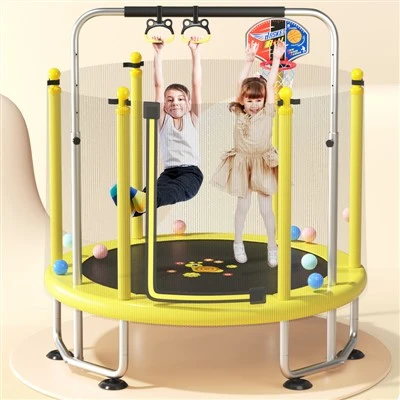
Before I wrap this up, let me just make this super clear: safety nets aren’t just a “toy add-on.” They’re the barrier between a kid (or adult) and a hard surface, between a bounce that stays on the mat and one that ends up on the edge. Worn-out ones don’t just look old—they stop working when you need them most. Don’t cut corners here.
Indoor Trampoline References:
- American Academy of Pediatrics. (2021). Trampoline Safety Guidelines for Home and Recreational Settings. Pediatrics, 148(3), e2021052285.
- Consumer Product Safety Commission. (2022). Trampoline-Related Injuries in the United States, 2011–2021. CPSC National Electronic Injury Surveillance System (NEISS) Data Brief.
- International Association of Amusement Parks and Attractions (IAAPA). (2020). Recreational Trampoline Safety Standards & Maintenance Protocols. IAAPA Safety Advisory Committee Report.
- Textile Institute. (2019). Tensile Strength Degradation of High-Density Polyethylene Mesh Under UV Exposure and Repeated Impact. Journal of Technical Textiles, 48(7), 1021–1038.
- Centers for Disease Control and Prevention (CDC). (2020). Preventing Trampoline-Related Injuries in Children. CDC Injury Prevention & Control Division Publication.
Zhejiang Aidi Industrial & Trading Co., Ltd.
As one of the most professional trampolines with safety nets manufacturers and suppliers in China, we also accept customized orders. We warmly welcome you to wholesale bulk durable trampolines with safety nets in stock here from our factory. If you have any enquiry about quotation and free sample, please feel free to email us.
Address: Yongkang City, Zhejiang Province
E-mail: Sales1@ykaidy.com
WebSite: https://www.cndibo.com/
