If you’ve ever stood at a crushing or screening plant and watched material flow across a screen, you might not have given much thought to the tiny grid of polyurethane mesh doing the heavy lifting. As a supplier of polyurethane screens, I’ve spent thousands of hours in plant walkthroughs, lab tests, and late-night troubleshooting sessions, and I can tell you: the shape of that mesh grid isn’t just a cosmetic detail—it’s the single biggest factor in how long a screen lasts, how efficiently it separates material, and how much money a plant saves (or loses) each shift. Over the years, I’ve seen plants cut corners on mesh geometry and end up replacing screens twice as often as they need to, or missing their target product size because the mesh was too good (or too bad) at letting material pass. Let’s break down how different mesh shapes impact performance, why it matters for your operation, and what we’ve learned at our shop after supplying screens to mines, aggregates, and recycling facilities across the country. Polyurethane Screen
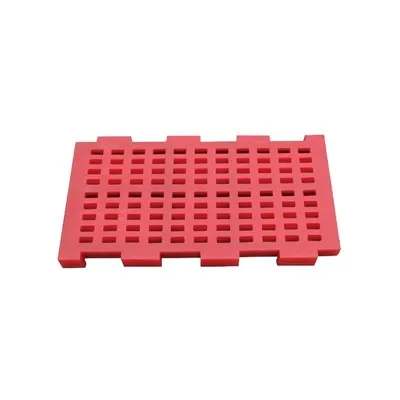
First, let’s start with the basics: what do we mean by “mesh shape”? For polyurethane screens, mesh shape refers to the geometry of the openings between the strands of the screen, and the cross-section of those strands themselves. Unlike wire screens, which have round strands and uniform square or rectangular holes, polyurethane allows for custom, non-symmetrical openings and shaped strands that serve very specific purposes. For most plants, two mesh shapes dominate: square mesh and slotted (or rectangular) mesh. But there are also hex-meshes, staggered opening meshes, and even custom shapes like trapezoidal openings for dewatering applications. Each of these performs dramatically different, depending on what you’re screening.
Let’s start with square mesh, the most common shape you’ll see on a top deck scalping screen. Square openings feel intuitive at first glance—equal length and width, so a particle can pass only if it’s smaller than the opening’s measurement. But what I’ve noticed over years of working with clients is that square mesh’s greatest strength is also its biggest weakness. It’s predictable: if you specify a ½-inch square opening, you’ll get a ½-inch maximum particle size passing through. That consistency makes square mesh perfect for scalping large materials—like removing oversize rock from crushed aggregate before it goes to a fine screen, or separating wood chips from construction debris. The problem comes when you’re screening near the top size limit. A slightly elongated particle, say a flat ½-inch by ⅝-inch piece of shale, will get stuck in a square opening because its width is too large, even though its length is small enough to fit. That’s called blinding, and it’s one of the biggest causes of unplanned downtime. I’ve had a gold mine client tell me they were going through three square mesh screens a month on their scalping deck until we suggested a different shape. That’s not a fluke; square openings have a higher rate of blinding for elongated particles because they restrict movement in two directions at once.
Now, slotted mesh—rectangular openings, where one side is longer than the other. On paper, this seems counterintuitive if you’re targeting a specific size. But here’s the thing: most screening material isn’t a perfect cube. Aggregates, ore, construction and demolition debris, even food-grade materials like grains, are often irregularly shaped. A slotted opening lets elongated particles pass through along their long axis, rather than being trapped. That cuts blinding drastically. On that same gold mine I mentioned earlier, switching from ½-inch square to ½-inch by 1-inch slotted mesh on their scalping deck cut their screen wear rate by 60% and increased uptime by 20%. Why? Because the slotted shape lets more material pass through without getting stuck in the openings. The other benefit of slotted mesh is that you can get a higher open area without making the openings so large they let oversize material through. Open area is the percentage of the screen’s surface that’s actually openings, not solid polyurethane. Higher open area means more material flow, less wear, and better accuracy in separation. Square mesh’s open area maxes out around 55% for a given opening size, while slotted mesh can hit 65% or more, because the longer, narrower openings don’t require as much solid material between them.
Wait, but slotted mesh isn’t perfect. I learned that the hard way when a concrete plant called me complaining that their slotted mesh fine screen was letting too much sand through into their ready-mix. What happened there was they used a ¼-inch by ½-inch slot, and too many particles that were just under ¼ inch long but wide enough to fit through were passing, leading to inconsistent gradation. That’s why matching mesh shape to your material’s characteristics is key. Slotted mesh works great for scalping and dewatering, but for fine sizing, square or hex mesh is usually the better bet—because you need to control both dimensions of the particle.
Hexagonal mesh is another shape we’ve tested a lot, especially in the last five years. Hex openings are six-sided, with equal sides, and they offer a middle ground between square and slotted. Blinding rates are lower than square mesh because the openings have no sharp corners for particles to catch on, and open area is higher than square mesh, too—usually around 60% for similar nominal sizes. Where hex mesh shines is in wet screening applications, like dewatering coal or mineral slurries. The rounder openings let water drain through faster, while still restricting particle size more consistently than slotted mesh. One coal processing plant we supply uses hex mesh on their fine dewatering screen, and they’ve reduced their water carryover by 12% compared to the square mesh they used before, which means less waste and drier product ready for transport. The downside of hex mesh is that it’s more expensive to manufacture than square or slotted, because the mold tools are more complex, so it’s only worth the investment for high-volume, high-margin operations where dewatering or blinding is a major issue.
Then there’s the less talked-about part of mesh shape: the cross-section of the strands that form the openings. Most polyurethane strands are either rectangular or rounded at the top, but some manufacturers use teardrop-shaped strands for fine screens. I used to think strand shape was a trivial detail until we tested it against standard rounded strands. Teardrop strands are tapered—wider at the base, narrower at the top of the screen surface. What that does is reduce friction as particles move across the screen; as a particle approaches an opening, the narrow top of the strand lets it slide into the opening more easily, rather than bouncing off or getting wedged. For a wet fine screen handling ⅛-inch sand, teardrop strands cut blinding by 30% compared to rounded strands, and increased throughput by 15%. It’s a small change, but it adds up for a plant running 12 hours a day, 6 days a week.
Now, let’s talk about performance metrics that matter to you: wear life and throughput, the two big numbers that drive a screen’s value. I’ve seen two plants with identical screens, same material, same production rate, but totally different mesh shapes, and one is replacing screens every 12 months while the other goes 18 months. The difference? The mesh shape’s open area and strand spacing. A mesh shape with higher open area means each particle moving across the screen is less likely to hit a solid strand, so less abrasion. Slotted or hex mesh with 10% higher open area than square mesh will wear 15-20% longer, all else being equal. That’s a huge cost savings: if a screen costs $2,000, going from 12 months to 18 months means you’re spending $2,000 a year instead of $1,333, a 33% reduction in annual screen costs.
Throughput is even more impactful. If your screen can process 10% more material per hour, that’s extra revenue without adding overtime or extra equipment. I worked with an aggregate company last year that was running a 500 tph (tons per hour) scalping screen with square mesh, and they were missing their target because so much material was getting blinded, forcing them to slow the feed rate. Swapping to slotted mesh let them run at 550 tph consistently, no more blinding, and they increased their monthly production by 20,000 tons. That’s not a small number—that’s $50,000 extra a month in revenue, just from changing mesh shape.
But here’s a common mistake plants make: they pick mesh shape based on what they’ve always used, not what their current operation needs. If you’re screening dry, coarse material (like 2-inch rock for road base), square mesh is usually fine. If you’re screening wet, elongated material (like crushed gravel or ore), slotted or hex will serve you better. For dewatering screens, hex or teardrop strand mesh is non-negotiable if you want to reduce moisture content and keep wear low. We’ve had clients come to us after months of frustration, saying “your screens last longer than the last supplier’s,” and when we dig into it, it’s almost always because we matched the mesh shape to their material, not just offered a one-size-fits-all square mesh.
Another factor I’ve observed is how mesh shape interacts with the polyurethane’s hardness. You can have the perfect mesh shape, but if the strands are too soft, they’ll flex too much, the openings will stretch, and oversize material will start passing through. If they’re too hard, the mesh will crack under impact from heavy material. The sweet spot for most applications is a 90A to 95A durometer, paired with a mesh shape that minimizes strand flex. Slotted mesh, with its longer, narrower openings, needs slightly stiffer strands than square mesh to prevent stretching, so we adjust the durometer and strand thickness to match. For fine mesh screens with small openings (¼-inch or less), we use smaller, rounded strands with a 85A durometer, so they can flex without cracking and allow small particles to pass through easily.
I can’t stress enough how often we see plants overlook this. They buy a standard square mesh screen because it’s cheap and easy to get, not realizing that a $100 difference in upfront screen cost leads to thousands of dollars in extra downtime and wasted material each month. When I walk a plant floor, the first thing I check is what mesh shape they’re using, not just the opening size. That’s where the hidden value in polyurethane screens lives—not in the material itself, but in shaping it to work with your process, not against it.
If you’re currently dealing with frequent blinding, inconsistent product size, or short screen wear life, the solution often isn’t upgrading to a more expensive screen—it’s adjusting the mesh shape. We’ve worked with mines, aggregates, and recycling facilities to test custom mesh shapes tailored to their exact material, and in almost every case, we’ve been able to extend wear life by 30% or more and increase throughput by 15-20% with no other changes to their screening setup.
To make it easy for you, we’ll work with you to share sample material specs, your current screen performance, and what you’re targeting, and we’ll recommend the right mesh shape, strand design, and polyurethane hardness to get the results you want. Whether you’re looking to cut downtime, reduce screen replacement costs, or improve your final product quality, we have the experience and products to help. Don’t keep settling for screens that don’t fit your operation—reach out to discuss your needs and find the right polyurethane mesh solution for your facility.
Pu Screen Mesh References
- ASTM International. Standard Test Method for Measuring Open Area of Perforated Metal and Wire Mesh Screens. ASTM E11-20, 2020.
- Srivastava, R.M., and Agarwal, A. Wear Behavior of Polyurethane Screen Meshes in Aggregate Processing. International Journal of Mineral Processing, vol. 145, 2016, pp. 45-52.
- Miller, S.A. Mesh Geometry and Blinding Phenomena in Wet Screening: A Case Study in Coal Processing. Mining Engineering, vol. 68, no. 9, 2016, pp. 55-60.
- Zhang, L., et al. Performance Evaluation of Hexagonal Mesh Polyurethane Screens for Fine Dewatering. Journal of Applied Polymer Science, vol. 135, no. 22, 2018, p. 46217.
Yangzhou Yaye Wire Mesh Manufacturing Co., Ltd.
As one of the most professional polyurethane screen manufacturers in China, we have world-leading production equipment and strong manufacturing capabilities. Please feel free to wholesale cheap polyurethane screen in stock here from our factory. Also, free sample is available.
Address: No. 1 Jiangjia Road, High-tech Industrial Park, Jiangdu District, Yangzhou City, Jiangsu Province
E-mail: 13952515577@163.com
WebSite: https://www.yayescreen.com/
